


Join our email list
Get exclusive deals and early access to new products.

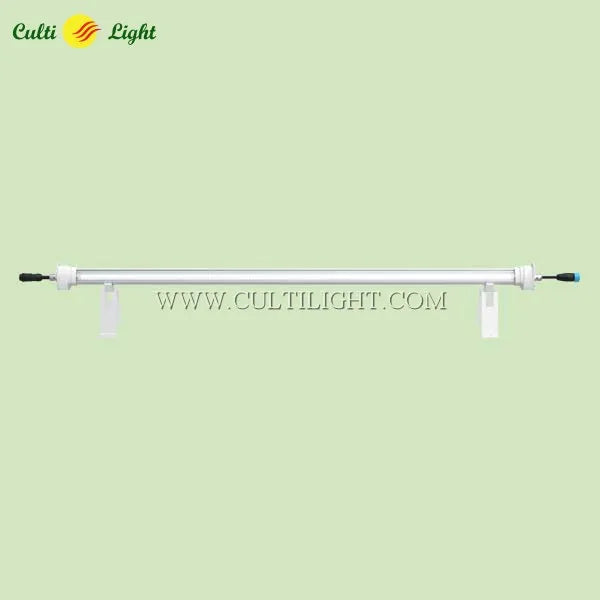
The CultiLight CL‑GL03‑150 is a powerful inter‑canopy LED grow light engineered for professional greenhouse and vertical farming applications. With 150 watts of output, it delivers high‑intensity supplemental lighting directly beneath the plant canopy, ensuring that lower leaves and fruits receive the same quality illumination as the top of the crop. This targeted approach improves photosynthesis efficiency, boosts yields, and enhances overall crop quality.
Unlike traditional overhead fixtures, the CL‑GL03‑150 is designed for flexible installation. It can be mounted as a hanging fixture or integrated as an under‑canopy grow light, making it ideal for high‑wire crops such as tomatoes, cucumbers, and cannabis, as well as leafy greens. Its double‑sided 120° radiation angle ensures wide, even coverage, reducing shadow zones and minimizing the number of fixtures required.
Built for durability, the housing is made of aluminum for excellent heat dissipation and corrosion resistance, while the polycarbonate (PC) optics transmit over 90% of visible light with outstanding impact resistance. Rated IP65, the fixture is dust‑tight and protected against water jets, ensuring reliable performance in demanding horticultural environments.
The CL‑GL03‑150 offers advanced efficiency with system efficacy up to 2.3 µmol/J and PAR output of 345 µmol/s. Daisy‑chain capability with M19 DC connectors and external driver options provide installation flexibility, while optional bracket and rope kits simplify mounting. ETL and CE certifications confirm compliance with international safety and quality standards.
For growers seeking a scalable, energy‑efficient solution, the CultiLight CL‑GL03‑150 inter‑canopy LED grow light delivers the performance needed to maximize yields, improve crop uniformity, and reduce energy costs. Backed by a 5‑year warranty, it’s the dependable choice for modern horticulture.


Under canopy lights, also known as supplemental or inter-canopy lighting, are a type of growing light that is designed to be installed beneath the canopy of cannabis or other plants particularly like high-wire crops like tomatoes and cucumbers.
Unlike the standard overhead grow lights, which are primarily illuminating the tops of the plants, the under-canopy lighting is deliberately placed beneath to illuminate the lower regions of the plant canopy to ensure that lower leaves and fruits receive adequate light.
Some of the benefits of inter-canopy.
Housing material:
Aluminum
Optics materials:
PC cover (transmission >90%)
Radiation angle:
Double-sided 120° each side
Protection degree:
IP65 (dust and watertight)
The housing material is made of aluminum for a good heat conduction and resistance to rust.
The optics materials are PC cover (transmission >90%)
Polycarbonate (PC) Transmits over 90% of visible light, ensuring bright and clear illumination
It as Highly durable and impact-resistant, making it less likely to break or shatter
The Weight Polycarbonate (PC) is lighter than glass, which can be beneficial for applications where weight is a concern.
The radiation angle of the light is of a spread of 120°.
This will be beneficial for having an even light distribution that will ensure a broad and even coverage, reducing the number of lights needed over your plants.
The protection degree is IP65 (dust and watertight)
Typically, the IP65 rating is a standard that indicates a high level of protection against both dust and water.
IP65 Protection Degree
The First Digit: 6 indicates a complete protection against dust ingress. This means that the device is dust-tight and that no dust can enter, ensuring reliable operation in a dusty environment.
The Second Digit: 5 indicates protection against water jets from any direction. While the device can withstand low-pressure water jets, it is not designed or suggested to be submerged in water.

ETL Certification
CE Certification
Low Voltage Directive (LVD)
Electromagnetic Compatibility Directive (EMC)
Restriction of Hazardous Substances (RoHS) Directive


Specification can vary depending on the spectrum used and updates to the light system. Please contact us for more details.
Item No.
CL-GL03-75
CL-GL03-150
Power consumption
75 W
150 W
System efficacy
2.3 µmol/J@56 V DC
2.3 µmol/J@56 V DC
PAR Output
173 µmol/s
345 µmol/s
ePAR Output
181 µmol/s
362 µmol/s
Voltage input
56 V DC
56 V DC
Current Range
1.5 A@56 V DC
3 A@56 V DC
Isolation Class
Class Ⅲ
Class Ⅲ
Heat BTU Generated
256 BTUs/h
512 BTUs/h
Dimming
0-10 V optional
0-10 V optional
Dimensions
1380 x 65 x 69 mm
54.33" x 2.56" x 2.72"
2500 x 65 x 69 mm
98.43”x 2.56" x 2.72"
Net Weight
1.5 kg/3.3 lbs
2.5 kg/5.5 lbs
Qty/CTN
4 pcs
4 pcs
G.W
7.0 kg/15.4 lbs
12.0 kg/26.5 lbs
CTN SIZE
1346 x 182x 198 mm
53”x 7.2”x 7.8”
2466 x 182 x 198 mm
97.1”x 7.2”x 7.8”
Operation conditions
0°C to 40°C/32°F to 104°F (95% RH)
0°C to 40°C/32°F to 104°F (95% RH)
Storage conditions
-40°C to 70°C/-40°F to 158°F (85% RH)
-40°C to 70°C/-40°F to 158°F (85% RH)
Warranty
5 Years
5 Years
Bracket Kit Features:
Bracket kit (12/25cm; 4.7/9.8” heights).

Rope kit 1*V hook attaches to 1*rope ratchet pulley.

We have many options as we can customize the type and length of the cables with different connectors according to your electrical requirements.
M19 DC connector and cable.

Grow lights come into play when you’re growing plants indoors — whether it’s due to limited natural light or simply because you’ll need to provide some artificial sunshine.
LED Grow Lights:
High-Intensity Discharge (HID) Lights:
How Do LED Grow Lights Work?
The term LED stands for Light Emitting Diode
LED use semiconductors and electroluminescence to generate light.
LED grow lights emit a type of light that’s very similar to sunlight or a spectrum customized base on your needs.
The plants absorb the lights and recognize this light to grow (photosynthesis)
LED grow lights are very efficient as they use very little electricity and emit minuscule amounts of heat.
And with LED grow light you can also customize the spectrum to the need of different plants to grow.
Some of the advantage to use LED Grow Lights are that they speed up the growth of the plants, encourage their flowering, and keep your plants very joyful and healthy.
CE certification
The CE certification, or Conformité Européenne (European Conformity), is a regulatory standard that ensures this product meet EU safety, health, and environmental protection requirements.
ETL certification
ETL certification is a mark of quality and safety for electrical, mechanical, and other products, it indicates that the product has been tested and meets the necessary safety standards for North America.
Also, the ETL mark is proof of compliance with North American safety standards. It is recognized by authorities and code officials across the US and Canada.
Low Voltage Directive (LVD)
The Low Voltage Directive (LVD), officially known as Directive 2014/35/EU, is a crucial piece of legislation in the European Union.
The LVD ensures that electrical equipment operating within certain voltage limits provides a high level of protection for European citizens.
It harmonizes the laws of EU member states for ensuring consistent safety standards across their market.
The products must ensure they meet essential health and safety requirements before they can be marketed in the EU.
Electromagnetic Compatibility Directive (EMC)
The Electromagnetic Compatibility Directive (EMC), officially known as Directive 2014/30/EU, is a key regulation in the European Union.
The purpose of the EMC Directive Is to ensure that the electrical and electronic equipment does not generate electromagnetic disturbances that could interfere with other devices. It also ensures that such equipment is not susceptible to interference from other sources.
Restriction of Hazardous Substances (RoHS) Directive
The Restriction of Hazardous Substances (RoHS) Directive, which is officially known as the Directive 2011/65/EU, is a significant regulation in the European Union aimed at protecting human health and the environment.
The Health and Environmental Protection directive restrict the use of specific hazardous substances in electrical and electronic equipment (EEE) to reduce environmental and health risks by promoting safer alternatives in the manufacturing of products.